.png?width=225&height=57&name=Untitled%20design%20(20).png)
AI Safety Monitoring Vendor Selection Scorecard for Multi-Site Warehouse Operators
Selecting an AI safety monitoring vendor is no longer just about comparing AI accuracy or camera specifications.
For warehouse operators managing multiple facilities, the bigger challenge is finding a platform that can integrate into existing operations, generate actionable alerts, and scale successfully across sites.
This scorecard outlines the evaluation criteria we believe matter most when comparing AI safety monitoring vendors, helping safety and operations leaders look beyond product demonstrations and marketing claims.
TL;DR
- Look beyond camera count. Prioritize platforms that combine video with operational data such as forklift telemetry, access control, or dock door status to improve alert quality.
-
Run a proof of concept first. Validate the platform at one facility before committing to a multi-site rollout.
-
Prioritize human-reviewed alerts. Early review workflows help reduce false positives and build trust before scaling automation.
- Human-in-the-loop review should be non-negotiable for anything that triggers an action (stopping equipment, alerting supervisors, locking a gate). Fully autonomous action on a false positive is a liability, not an efficiency gain.
-
Ask about alert quality, not just accuracy. Fewer meaningful alerts are more valuable than high detection rates with excessive noise.
-
Evaluate total cost of ownership. Include integration work, hardware compatibility, tuning, training, and ongoing support—not just licensing.
-
Plan for future expansion. Camera compatibility and open integrations become increasingly important as deployments grow.
Direct Answer
The best way to evaluate an AI safety monitoring vendor is to use a structured scorecard instead of relying on product demonstrations or AI accuracy claims alone.
A comprehensive evaluation should consider five areas:
• Integration depth
• Human review workflow
• Proof-of-concept (POC) structure
• Alert precision and quality
• Total cost of ownership
Once you’ve shortlisted vendors, validate them through a single-site proof of concept before expanding to additional facilities. Testing the platform using your own cameras, workflows, and operating conditions provides a much clearer picture of long-term performance than a product demonstration alone.
Why Camera Count and "AI Accuracy %" Are the Wrong First Filters
Many AI safety monitoring vendors highlight camera capacity, AI accuracy, or detection speed as key differentiators. While these metrics are important, they rarely determine whether a deployment will succeed across multiple warehouse sites.
The more important question is whether the platform consistently produces actionable alerts that supervisors trust and can incorporate into day-to-day operations.
- Accuracy numbers are usually measured on the vendor's own curated test set, not your dock doors, your lighting conditions, or your seasonal inventory stacking patterns.
- A single-camera object detection model (person-in-zone, PPE-on/off) generates false positives at a rate that overwhelms safety teams within weeks — a forklift operator wearing a dark vest against a dark pallet, a worker bending to tie a shoe, a shadow crossing a geofence line. Without a second data source to confirm context, your team either turns off alerts or ignores them.
- What actually predicts success at scale is whether the system fuses multiple signal types — video plus access control logs, plus machine telemetry (forklift speed, dock door state), plus environmental sensors (temperature, gas detection where relevant). That fusion is what separates "a camera flagged motion" from "a forklift entered a pedestrian zone at 8 mph while the dock door was open and no badge scan cleared that zone in the last two minutes."
Scorecard Tip #1: Ask each vendor to name every non-video data source their platform ingests natively, and get a live demo of an alert that required two or more signal types to trigger. If they can't show this, they're a single-modality vision tool wearing an "AI safety platform" label.
The Scorecard: Five Weighted Criteria
Use this as a working rubric during vendor demos. Suggested weighting is a starting point — adjust based on your site count and risk profile.
| Criterion | Weight | What To Ask | Red Flag Answer |
|
Multi-modal integration |
25% |
“What data sources beyond video do you fuse, and can you demonstrate a live alert that combines two or more data sources?” |
“We’re working on that in a future release.” |
|
Human-in-the-loop |
20% |
“Walk me through what happens between detection and action. Who reviews or confirms an alert before equipment is stopped or supervisors are notified?” |
“The system acts automatically without review.” |
|
POC structure |
20% |
“Can we run a 30–60 day pilot at a single site before making a broader commitment?” |
“Our standard contract requires a multi-site commitment.” |
|
Alert quality |
20% |
“What’s your alert-to-actionable-event ratio in a live deployment? How do you measure false positives?” |
Vendor only cites AI detection accuracy. |
|
Total cost of ownership |
15% |
“What costs aren’t included in your proposal? Does it include hardware compatibility, implementation, integration, training, and ongoing tuning?” |
Quote only includes software licensing. |
Score each vendor 1-5 per criterion, multiply by weight, and total. A vendor scoring high on accuracy claims but low on human-in-the-loop and POC flexibility should still lose to a vendor with moderate accuracy but strong integration and a real pilot path — because the second vendor is the one your team will actually trust and keep running past month three.
Read more: Vendor Comparison page
Decision Framework: Matching Vendor Type to Your Situation
Every warehouse operation has different priorities. A single-site manufacturer evaluating its first AI safety monitoring platform will have different requirements than a logistics company deploying across multiple distribution centers.
The recommendations below highlight where to place additional emphasis based on your operational environment.
If you operate 1-3 sites and have an internal safety analytics team, prioritize vendors offering open APIs and raw data export over turnkey dashboards — you have the capacity to build custom views, so pay less for polish and more for data access.
If you operate 10+ sites with lean regional safety staff, prioritize vendors with proven human-in-the-loop review workflows and centralized alert triage — you need the vendor (or a shared reviewer pool) to filter noise before it reaches site managers, not a firehose of raw alerts to every location.
If your existing camera infrastructure is a mix of legacy analog CCTV and newer IP cameras, prioritize camera-agnostic vendors that can ingest existing NVR feeds over vendors requiring proprietary hardware. Hardware replacement costs should be evaluated separately from software licensing because they can substantially affect the total cost of deployment.
If your primary risk driver is forklift/pedestrian interaction rather than PPE compliance, prioritize vendors that fuse machine telemetry (speed, proximity) with video over vendors that only do visual zone-crossing detection — visual-only zone detection has known blind spots with occlusion and lighting.
If you're under insurance or OSHA-driven pressure to show a documented safety program quickly, prioritize vendors with fast POC timelines (30-45 days) and clear reporting templates over vendors promising the most advanced feature roadmap 12 months out.
Worked Example: Scoring Two Hypothetical Vendors for a 12-Site DC Network
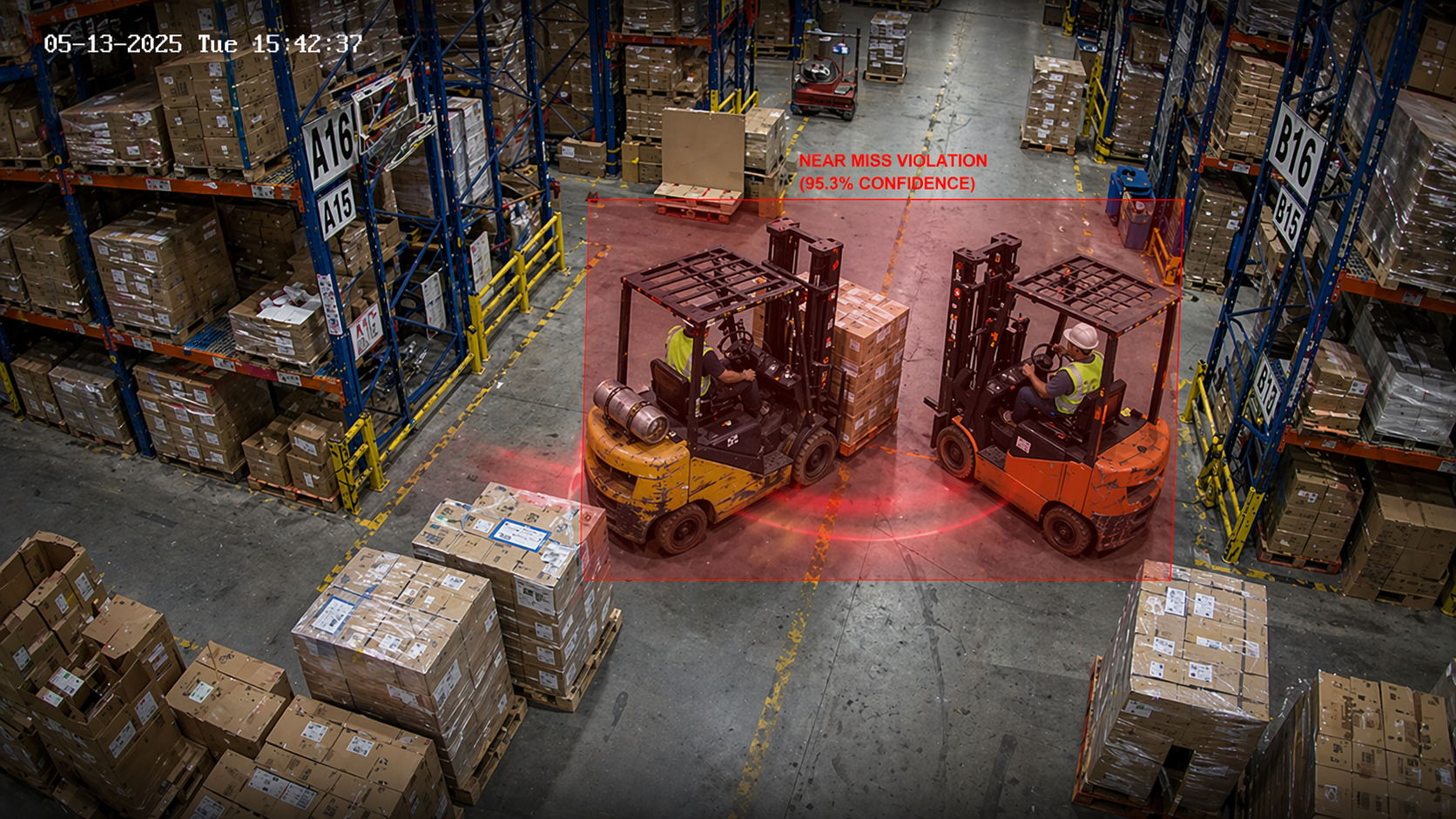
Imagine a regional third-party logistics provider (3PL) operating 12 distribution centers. After a forklift near miss prompts a review of existing safety processes, the company begins evaluating two AI safety monitoring vendors.
Vendor A offers camera-based PPE and zone detection only, requires proprietary cameras throughout the facility, and its standard contract requires committing to all 12 sites within 90 days to receive preferred pricing.
Vendor B fuses existing CCTV feeds with forklift telemetry (already installed via a separate fleet management system) and dock door sensor state, offers a single-site 45-day pilot at one DC before any further commitment, and routes every consequential alert through a human reviewer who confirms before a supervisor is paged.
| Criterion | Vendor A | Vendor B |
| Multi-modal integration | 1/5 | 4/5 |
| Human-in-the-loop workflow |
1/5 | 5/5 |
| POC structure | 2/5 | 5/5 |
| Alert quality | 3/5 | 4/5 |
| Total cost of ownership | 2/5 | 4/5 |
Although Vendor A delivered a polished demonstration, it scored poorly in the areas that have the greatest impact on long-term operational success.
Vendor B scored higher because it integrated with existing infrastructure, supported a structured proof of concept, and included a human-reviewed workflow that reduced deployment risk. In this scenario, the scorecard helps separate an impressive demonstration from the platform that is more likely to succeed in day-to-day operations.
Where This Scorecard Approach Breaks Down
This rubric assumes you have the internal bandwidth to run a genuine 30-60 day pilot with real usage data before scoring — if your team is stretched too thin to staff even a single-site pilot properly, the scorecard's weighting on "real-world alert precision" becomes guesswork based on vendor claims instead of your own data.
It also assumes your sites have broadly similar camera/network infrastructure; if your 12 sites range from a brand-new automated DC to a 20-year-old facility with degraded analog cameras, you may need different vendor tiers per site rather than one winner-take-all selection.
Finally, this scorecard weighting is a starting point, not a fixed formula — a facility in a high-severity-incident industry (e.g., cold storage with forklift-pedestrian risk) should weight human-in-the-loop and multi-modal fusion higher than the 20-25% suggested here, while a lower-risk facility focused mainly on compliance documentation might weight TCO more heavily.
FAQ
What's the biggest mistake warehouse operators make when selecting an AI safety monitoring vendor?
The most common mistake is signing a multi-site contract based on a demo or a single-site accuracy claim without running a real pilot on their own cameras, lighting, and workflows first. Vendors that discourage a scoped proof of concept before a bigger commitment are signaling they're not confident the system will perform in your actual environment.
Should AI safety systems take fully autonomous action, like automatically stopping equipment?
Most safety and operations leaders prefer a human-in-the-loop model where a person reviews and confirms before any consequential action — like locking equipment or notifying a large group — because false positives in fully autonomous systems create both safety and trust risks. A reviewed-alert workflow also creates an audit trail that's useful for OSHA documentation and insurance conversations.
How long should a proof of concept for AI safety monitoring run before a multi-site rollout?
A typical proof of concept runs 30 to 60 days on a single site or line, long enough to capture normal operational variation (shift changes, seasonal volume shifts) without dragging out the decision. If a vendor's proposed pilot is shorter than two weeks or requires immediate multi-site sign-off to "lock in pricing," treat that as a negotiating tactic rather than a technical necessity.
Does AI safety monitoring work with existing CCTV cameras, or do we need new hardware?
Many platforms can ingest existing NVR/CCTV feeds and fuse them with other data sources like access control or machine telemetry, avoiding a full hardware replacement — but this varies significantly by vendor and camera age/resolution. Confirm camera compatibility and any minimum resolution or frame-rate requirements before scoring a vendor on cost, since hardware refresh costs can dominate a multi-site budget.
What data sources besides video actually improve safety alert accuracy in warehouses?
Access control logs (badge scans), machine telemetry (forklift speed and location), dock door sensor state, and environmental sensors all add context that reduces false positives compared to video-only detection. A vendor that fuses two or more of these with video is generally better positioned to distinguish a real hazard from routine activity than one relying on visual detection alone.
Ready to see how a scoped pilot would work for your sites? Check our POC Prequalification page to find out if your facility qualifies for a single-site proof of concept.