.png?width=225&height=57&name=Untitled%20design%20(20).png)
What Is a BBS Safety Program? The 7-Step Process, Checklists, and the Manual Observation Problem
TL;DR
- A Behavior-Based Safety (BBS) program is a proactive process that uses structured observation to reinforce safe behaviors and correct at-risk actions before they cause incidents.
- Most BBS programs fail or plateau within 18 months due to reliance on manual observation, which suffers from inconsistency, observer fatigue, and data quality decay.
- A successful BBS program requires a Critical Behavior Checklist of 15-25 specific, observable actions, developed by analyzing past incident data and job hazard analyses.
- Observer training is not a one-time event; it requires quarterly calibration sessions to maintain inter-observer reliability (the consistency between observers) above a target of 85%.
- Effective BBS programs focus on fixing systemic issues (antecedents) that cause at-risk behavior, not on blaming workers. Data is used as a diagnostic tool for system improvement.
You've seen it happen. A manufacturing plant launches a behavior-based safety (BBS) program with strong executive sponsorship. The team trains 40 peer observers, rolls out the checklists, and sees a 30% drop in at-risk behaviors within the first six months. The initial energy is high. Then, by month 14, the observation completion rate has fallen to 35% of its target. The data shows suspiciously high percent-safe scores that no longer correlate with actual incident trends. The steering committee meetings devolve from discussing behavioral insights into chasing observation quotas.
This isn't a hypothetical failure. It's the most common outcome for BBS programs that rely entirely on manual observation. The methodology is sound, but the data collection engine stalls.
A behavior-based safety (BBS) program is a systematic, data-driven approach that uses structured observation to identify, measure, and reinforce safe workplace behaviors while correcting at-risk actions before they lead to incidents. Most definitions stop there. But a BBS program is only as reliable as its observation data and manual observation is where the methodology's core assumptions often break down under operational pressure.
This guide covers how a BBS safety program works in practice: the psychological model, the 7-step implementation process, how to build a critical behavior checklist, and what metrics to track. Most importantly, it confronts why so many programs fail and what it takes to sustain a behavioral feedback loop at scale.
What Is a BBS Safety Program and What Is Its Primary Goal?
A behavior-based safety (BBS) program is a proactive, data-driven approach that systematically observes, measures, and modifies worker behaviors to prevent workplace injuries and incidents before they occur.
The primary goal of a behavior-based safety program is to reduce workplace injuries by identifying and reinforcing safe behaviors while systematically correcting at-risk actions before they lead to incidents.
This approach adds a critical layer of leading indicators to a traditional safety program. A traditional program focuses on engineering controls, administrative rules, and lagging indicators like incident rates or lost-time injuries. It primarily asks, "Did someone get hurt?" A BBS program, in contrast, asks, "Are people consistently doing the things that prevent them from getting hurt?"
For example, after a worker suffers a hand injury, a traditional program investigates the incident. A BBS program, through observation, aims to identify and correct the improper glove use or incorrect tool selection before that injury ever happens. It shifts the focus from reaction to prevention by measuring the behaviors that precede incidents.
|
Term |
Definition |
|
BBS |
A systematic process for improving safety by influencing employee behavior through observation and feedback. |
|
BBS Observation |
A structured, formal process where trained personnel watch work to document safe and at-risk behaviors. |
|
At-Risk Behavior |
An action that increases the probability of an injury or incident occurring. |
|
Safe Behavior |
An action that reduces the probability of an injury or incident. |
|
Critical Behavior |
A specific behavior that has been statistically linked to past incidents or has high-risk potential. |
The Antecedent-Behavior-Consequence (ABC) Model: The Psychology Behind BBS
The Antecedent-Behavior-Consequence (ABC) model, drawn from Applied Behavioral Analysis (ABA), is the psychological framework underlying all behavior-based safety programs it explains why workers behave unsafely even when they know the rules.
Let's walk through the model with a specific industrial scenario: a forklift operator in a busy distribution center.
- Antecedent: This is the trigger that comes before the behavior. The operator's supervisor asks them to move a pallet quickly because a truck is waiting at the loading dock. The antecedents are time pressure and a direct instruction from a superior.
- Behavior: This is the observable action. The operator, feeling rushed, drives the forklift through a designated pedestrian zone without honking the horn at the intersection. This is the at-risk behavior.
- Consequence: This is what happens immediately after the behavior. The pallet gets moved on time, the truck is loaded, the supervisor says nothing, and critically no one gets hurt. The consequence is positive and immediate from the operator's perspective (task completion, no negative feedback), which powerfully reinforces the at-risk behavior.
The at-risk behavior is now more likely to happen again because its consequence was favorable. BBS programs work by systematically redesigning this consequence structure.
In a BBS intervention, a trained observer sees the behavior. They might start with positive feedback on something done correctly ("I noticed you had that pallet perfectly centered and secured great job."). Then, they initiate a coaching conversation about the at-risk action ("I saw you went through the intersection without using the horn. What are the barriers to using it every time?").
The consequence hierarchy shifts. Safe behavior gets immediate, positive reinforcement. At-risk behavior gets a non-punitive, corrective conversation. The program fails when it focuses only on the consequence (punishment) and ignores the antecedent (the time pressure from the supervisor). The goal isn't just to "correct" the operator; it's to analyze why the at-risk behavior was the path of least resistance and fix that systemic issue. Frameworks like Scott Geller's ACTS process (Actively Caring for Total Safety) and Terry McSween's Values-Based Safety Process are different ways of operationalizing this ABC model to make safe behavior the easier, more rewarding choice.
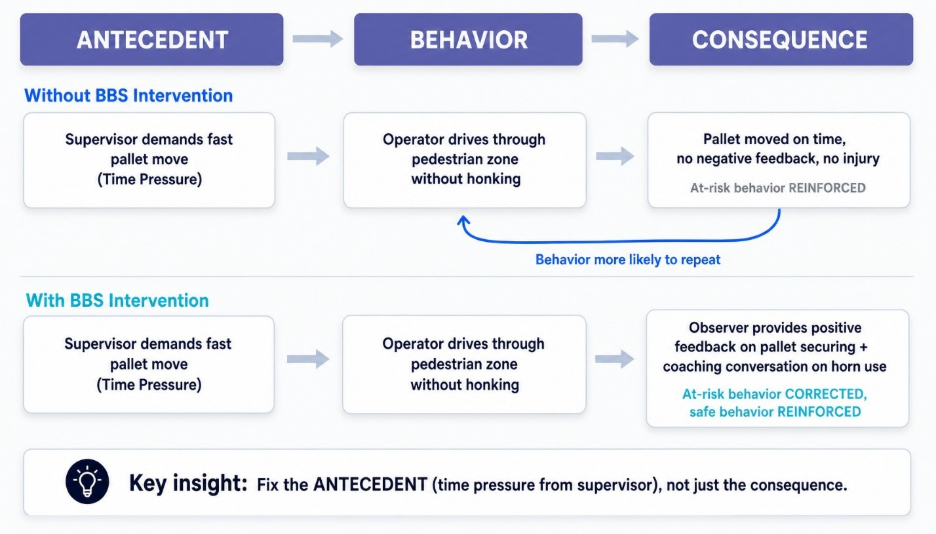
The ABC model explains why workers repeat at-risk behaviors even when they know the rules.
The 7 Steps of the Behavior-Based Safety Process
The behavior-based safety process follows seven sequential steps, from identifying critical behaviors through continuous improvement each step produces a specific output that feeds the next.
- Identify Critical Behaviors. The process begins by analyzing your site's incident data, near-miss reports, and Job Hazard Analyses (JHAs). The goal is to pinpoint the handful of behaviors that are most directly correlated with injury risk. Output: A Critical Behavior Inventory (CBI), a list of 15-25 specific, observable, high-risk behaviors for your site.
- Develop Observation Checklists. Using the CBI, the design team creates a standardized checklist. This tool ensures that all observers are looking for the same things and that data is collected consistently. Output: A one-page observation checklist that observers use to record instances of safe and at-risk behaviors.
- Train Observers. A cross-section of employees frontline workers, supervisors, and managers are trained on how to conduct observations. The training covers how to pinpoint behaviors, provide constructive feedback, and record data accurately. Output: A calibrated pool of peer observers who can identify and score behaviors with high inter-observer reliability (over 85% agreement). The most common way this step goes wrong is treating observer training as a one-time event. Without periodic calibration sessions where multiple observers independently score the same work scenario and compare results inter-observer reliability degrades within 8-12 weeks, and the data becomes unreliable without anyone noticing.
- Conduct Observations. Observers carry out short, planned observations of routine work tasks. These are not "gotcha" inspections; they are opportunities to gather data and engage with peers about safety. Output: Raw behavioral data, collected at a target frequency (e.g., one observation per supervisor per week).
- Provide Immediate Feedback. This is the most critical part of the observation. The observer has a brief, on-the-spot conversation with the worker(s), providing positive reinforcement for safe behaviors and coaching on at-risk behaviors. Output: A real-time coaching conversation that reinforces safe habits and corrects risky ones.
- Analyze Data and Identify Trends. The data from all observation checklists is collected and analyzed by a safety steering committee. They look for patterns and trends to identify the most frequent at-risk behaviors across the site, department, or shift. Output: A behavioral trending report that highlights which at-risk behaviors are increasing, decreasing, or plateauing.
- Implement Corrective Actions and Reassess. The steering committee uses the data to drive improvements. This isn't about blaming individuals; it's about identifying and removing barriers. If many workers are observed taking a shortcut, the committee investigates why that shortcut is preferable. Output: A process of barrier removal (fixing the antecedents) and an updated CBI or checklist reflecting new priorities. Commercial methodologies like the DuPont STOP™ program are well-known implementations of this structured, cyclical process.
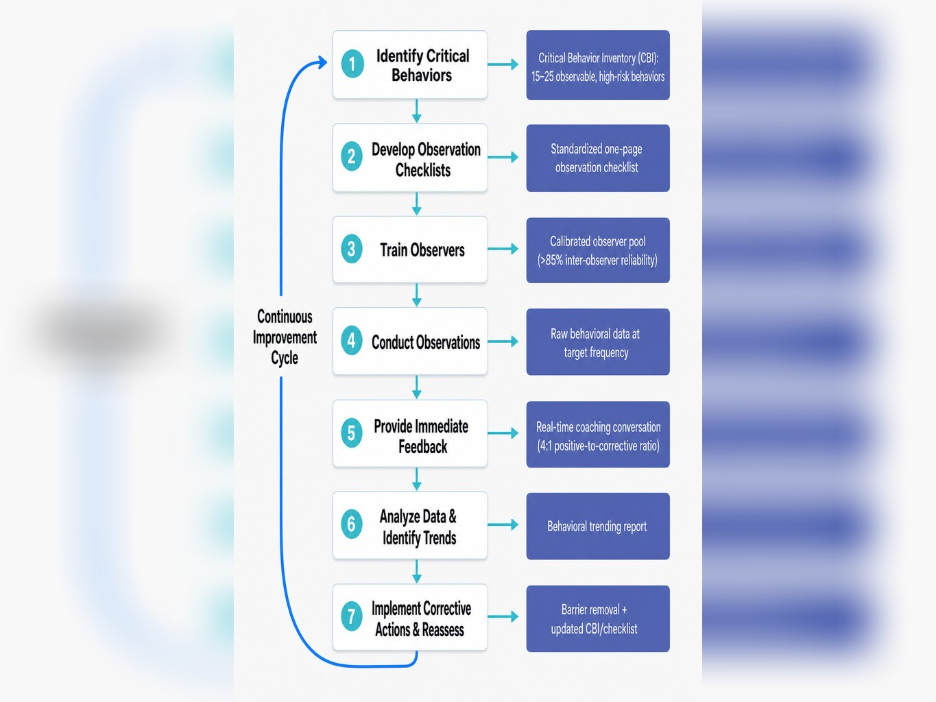
Each step in the BBS process produces a specific output that feeds the next.
How to Develop a Critical Behavior Checklist for BBS Observations
A critical behavior checklist is developed by analyzing incident data, near-miss reports, and job hazard analyses to identify the 15-25 specific, observable behaviors that most directly correlate with injury risk at a given site. A well-designed checklist is the foundation of reliable data collection.
When selecting behaviors for your checklist, ensure each one meets three criteria:
- Observable: You can see it happen.
- Within the worker's control: It's an action the individual can choose to do or not do.
- Stated positively: It describes what to do, not what not to do (e.g., "Maintains 3 points of contact on ladder" instead of "Doesn't overreach on ladder").
Here is a sample template organized by risk category.
BBS Observation Checklist Template
- 1. PPE Compliance: (Principle: Easiest to observe, but least predictive of serious injuries.)
- Hard hat worn in designated zones.
- Safety glasses/goggles worn during grinding/cutting.
- Hearing protection used in areas >85 dB.
- 2. Fall Protection: (Principle: High-consequence, procedure-driven behaviors.)
- Personal fall arrest system inspected before use.
- Lanyard attached to a rated anchor point above shoulder height.
- Guardrails or hole covers in place at leading edges.
- 3. Line-of-Fire Awareness: (Principle: Critical for preventing serious injuries and fatalities (SIFs).)
- Worker positioned outside swing radius of mobile equipment.
- Hands/body clear of pinch points during machine operation.
- Stands clear of suspended loads.
- 4. Housekeeping: (Principle: Reflects overall site discipline and prevents common slips/trips/falls.)
- Walkways and work areas clear of cords, hoses, and debris.
- Spills are cleaned up or cordoned off immediately.
- 5. Tools and Equipment: (Principle: Connects behavior to equipment condition.)
- Correct tool selected for the task.
- Safety guards are in place and functional on rotating equipment.
- Tools inspected for damage before use.
- 6. Ergonomics / Body Mechanics: (Principle: Prevents cumulative trauma disorders.)
- Lifting with legs, not back, for loads over 15 kg (35 lbs).
- Workstation/task height adjusted to minimize awkward postures.
- Avoids excessive twisting while lifting/carrying.
- 7. Lockout/Tagout (LOTO): (Principle: Zero-tolerance behaviors for energy isolation.)
- Energy sources are de-energized and verified at zero-energy state before work.
- Personal lock and tag are physically applied to the isolation point.
- 8. Chemical Handling: (Principle: Focuses on information and containment.)
- Safety Data Sheet (SDS) reviewed before first use of a new chemical.
- Proper ventilation confirmed for work in enclosed spaces.
Avoid checklists with vague items like "works safely." This is not an observable behavior, it cannot be measured, and it produces meaningless data that can't be trended or acted upon. Specificity is what makes the data useful.
How to Train Observers for Behavior-Based Safety Observations
BBS observer training typically requires 4-8 hours of initial instruction covering observation techniques, behavioral pinpointing, feedback delivery, and data recording, followed by 1-2 hour quarterly calibration sessions to maintain inter-observer reliability.
The quality of your BBS data is directly proportional to the quality of your observers. Effective training covers four core modules:
- Behavioral Pinpointing: This is the skill of distinguishing between specific, observable behaviors and vague judgments. Trainees learn to document "worker grips handrail with one hand while descending stairs" instead of "worker is careful on stairs." This precision is non-negotiable for collecting actionable data.
- The Observation Process: This module covers the logistics. How to position yourself to see the work without being intrusive, how long to observe (typically 15-30 minutes), and how to decide when to intervene immediately versus when to document and discuss afterward.
- Feedback Delivery: This is the most crucial skill. Observers are taught to aim for a 4:1 ratio of positive reinforcement to corrective feedback. They practice framing corrective feedback as a collaborative question ("I noticed you reached across the conveyor what would make it easier to access that part from the safe side?") rather than a directive ("Don't reach across the conveyor."). The goal is a coaching conversation, not a confrontation.
- Data Recording: Trainees learn how to fill out the observation card accurately and consistently, including how to handle ambiguous situations or behaviors not on the checklist.
The biggest mistake organizations make is treating this as a one-off class. Observer skills decay. To counter this, you must conduct calibration exercises. In a typical calibration, 3-4 observers independently watch and score the same 10-minute work scenario (either live or on video). They then compare results. If one observer scores the task as 90% safe and another scores it at 65%, it reveals calibration drift. This process is essential for maintaining inter-observer reliability the percentage of agreement between independent observers which should be kept above 85%. Digital observation tools from providers like SafetyCulture (iAuditor) or Intelex can help flag inconsistent scoring patterns between observers, making it easier to spot who needs retraining.
Why BBS Safety Programs Fail: The 18-Month Plateau and the Manual Observation Bottleneck
Most BBS safety programs show measurable results in the first 6-12 months, then plateau or quietly decay not because the methodology is wrong, but because manual observation cannot sustain the behavioral feedback loop at the frequency, consistency, and objectivity the program requires.
This decay happens through five predictable failure modes:
-
Observation Fatigue: Observers are volunteers with full-time jobs. After the initial enthusiasm fades, the "real work" takes priority. Observation completion rates often drop by 40-60% after the first year as novelty wears off and workload pressures return. The program's data stream dwindles to a trickle.
-
Data Quality Decay: Without rigorous calibration, percent-safe scores drift upward. Observers, consciously or not, start avoiding difficult conversations by not documenting at-risk behaviors. This "penciling" of high scores creates a false picture of improvement. A chemical plant that saw its percent-safe scores climb to 96% while near-miss reports simultaneously declined wasn't getting safer; its observers were just under-reporting.
-
Steering Committee Stagnation: As data quality and quantity decline, the steering committee has nothing meaningful to analyze. Meetings shift from discussing behavioral trends to chasing observation quotas. The purpose is lost, and the program becomes compliance theater.
-
Antecedent Blindness: The program successfully identifies recurring at-risk behaviors but fails to remove the upstream conditions (antecedents) that cause them like time pressure, poor tool design, or inadequate staffing. When the system isn't fixed, the same behaviors inevitably return, and workers lose faith in the process.
-
The Psychological Safety Paradox: In cultures where workers fear discipline, observation data becomes performative. Workers modify their behavior only when they know an observer is present, and observers under-report to protect their colleagues. The data no longer reflects typical behavior, rendering it useless for diagnosis.
This last point connects to a valid historical criticism from organized labor: that BBS can be used to shift responsibility from the employer (who is responsible for providing a safe workplace) to the worker. This is true when BBS is used as a substitute for engineering controls or when observation data is tied to discipline.
A well-designed program uses observation data as a diagnostic tool for system improvement, not as evidence against individuals. Data from the Cambridge Center for Behavioral Studies shows BBS can reduce recordable injuries by 26-60%, but sustaining those gains requires a robust and trustworthy observation infrastructure.
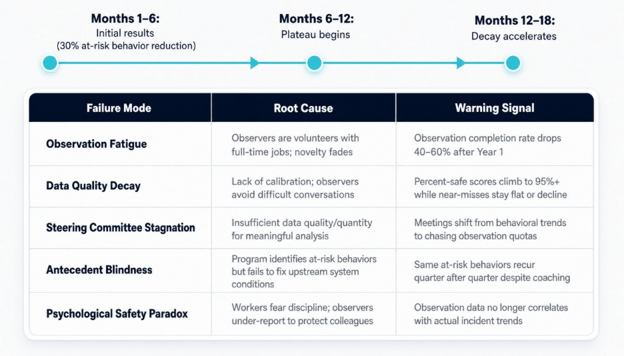 Most BBS safety programs plateau within 18 months through these five predictable failure modes.
Read more: AI Intelligent Detection & Computer Vision Guide | Rainscales
What Metrics Should a BBS Steering Committee Track?
A BBS steering committee should track five core metrics weekly: percent safe score, observation frequency rate, participation rate, corrective action closure rate, and behavioral trending by category. These metrics provide a quantitative view of the program's health and impact.
- Percent Safe Score: Calculated as (Number of Safe Observations / Total Observations) × 100. This should be used as a trend indicator, not an absolute grade. Target: Look for trends over time. A score that never drops below 90% is a red flag for observation bias, not a sign of a perfectly safe workplace.
- Observation Frequency Rate: The Total Observations Completed / Target Observations per Period. This measures whether the program is generating enough data. Target: >80% completion against the plan (e.g., if the target is 100 observations a month, you should be getting at least 80).
- Participation Rate: The Percentage of Trained Observers Who Completed at Least One Observation in the reporting period. This tracks engagement and identifies observer fatigue. Target: >70% active participation.
- Corrective Action Closure Rate: The Percentage of Identified Barriers or Systemic Risks That Have Been Resolved within the target timeframe (e.g., 30 days). This is the most important output metric. It measures whether the program is driving change or just generating paper.
- Behavioral Trending: This involves tracking specific at-risk behaviors over time to see which are improving, which are static, and which are worsening. For example, you might see "improper body mechanics during lifting" decrease while "line-of-fire violations" remain flat. This tells you where to focus your efforts. For accurate comparisons across sites or shifts, normalize this data by exposure hours.
Steering committees often use dashboards in tools like Power BI or dedicated EHS platforms like Cority to automate these calculations. A critical warning: never tie percent-safe scores to supervisor performance reviews or bonuses. This is the fastest way to incentivize under-reporting and destroy the integrity of your data.
How to Analyze BBS Observation Data and Close the Corrective Action Loop
Analyzing BBS observation data means identifying systemic at-risk behavior patterns, tracing them to their root antecedents, assigning corrective actions to remove barriers, verifying completion, and feeding results back to observers and frontline workers to close the loop.
Data without action is waste. Here is the workflow to turn observation trends into tangible safety improvements, using a food processing plant as an example:
- Step 1: Identify the Trend. The steering committee reviews the data and finds that "failure to lock out conveyor before clearing a jam" appears in 23% of maintenance observations over the last three months. This is flagged as a systemic trend, not a series of individual compliance failures.
- Step 2: Conduct Root Cause Analysis. The committee investigates why this is happening. They discover the antecedent: the main energy isolation point is 40 meters away from the most common jam location, and clearing jams is a time-sensitive task because production stops. The at-risk behavior is a rational response to an inefficient system design.
- Step 3: Assign a Corrective Action. The corrective action is not "retrain the workers on LOTO procedures." It is an engineering control: "Install a local isolation switch within 3 meters of the common jam points." This action is assigned to the engineering department with a 30-day completion target.
- Step 4: Verify the Fix. After the new switch is installed, the committee re-observes the same task category for four weeks. They are looking for data that confirms the fix was effective.
- Step 5: Close the Feedback Loop. The committee shares the before-and-after data with the entire maintenance crew and all observers. They show that the at-risk behavior dropped from 23% to 4% after the barrier was removed.
This process demonstrates that the program is about fixing the system, not blaming the person. It connects BBS directly to the hierarchy of controls and builds trust that observations lead to real improvements.
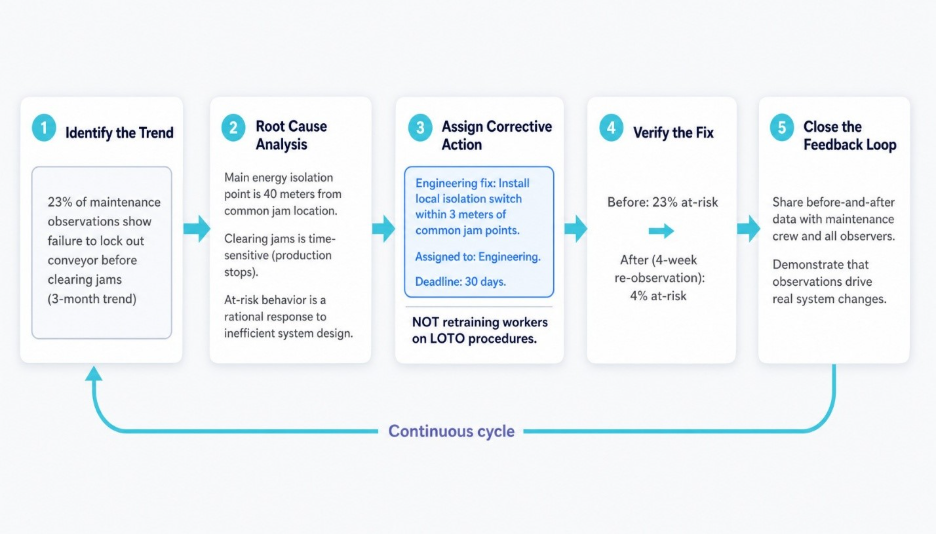
Effective BBS programs fix the system that causes at-risk behavior, not blame the worker.
Read more: Intelligent Detection Guide | Manufacturing | Rainscales
Moving Beyond Manual Observation: How Continuous Detection Sustains the BBS Feedback Loop
The central tension of any BBS program is clear: the methodology depends on consistent, high-frequency, unbiased behavioral observation, but manual observation is inherently inconsistent, low-frequency, and subject to bias. The corrective action loop only works if the input data is reliable. This is the structural gap where modern detection capabilities can transform a program's effectiveness.
Deploying an AI-driven intelligent detection platform is not a replacement for peer-to-peer observation, which provides irreplaceable coaching and engagement value. Rather, it serves as a continuous, objective observation layer that fills the vast gaps between manual checks. Your existing CCTV cameras already capture work activity 24/7 across every shift. When deployed as a managed AI detection service, it turns that passive video into a proactive source of behavioral data.
These proactive AI detection technologies can identify at-risk behaviors like PPE non-compliance, line-of-fire exposure, unauthorized zone entry, and ergonomic risk postures not just during the 15-minute windows when an observer happens to be watching, but continuously. Unlike simple object detection, our platform understands context. It can evaluate multiple conditions in a single view such as worker posture, proximity to moving equipment, and PPE status to identify complex risk scenarios.
This gives your steering committee behavioral trending data that reflects actual site conditions, not the filtered, intermittent snapshot that manual observation provides. In an AI detection-driven managed service model, the provider handles the model configuration, tuning, and monitoring. Your safety team stays focused on acting on insights, not on managing AI infrastructure.
The BBS methodology is sound; the manual observation infrastructure is the bottleneck. Continuous, context-aware detection provides the reliable data stream needed to sustain the feedback loop that manual observation alone cannot maintain.
How BBS Fits Within an EHS Management System
BBS sits within the administrative controls layer of the hierarchy of controls it supplements but does not replace elimination, substitution, and engineering controls, and it should never be used as a substitute for fixing hazardous conditions.
Its most effective role is as a leading-indicator system that feeds data upstream. When observation data reveals persistent at-risk behaviors, the most appropriate response is often an engineering fix or a process redesign, not more behavioral coaching.
In the context of formal management systems:
- ISO 45001: BBS observation data is a powerful input for Clause 6.1.2 (Hazard identification and assessment of risks and opportunities). It provides structured, real-world data on how work is actually performed, enriching traditional risk assessments.
- OSHA VPP (Voluntary Protection Programs): A well-run BBS program is frequently cited as strong evidence of "Employee Involvement," one of the four core elements of VPP. It demonstrates a mature, proactive safety culture where employees take ownership of safety management.
The most common misuse of BBS is when an organization uses it as its primary safety strategy while neglecting fundamental engineering controls. This is the valid criticism often raised by organized labor and safety purists. BBS works best when it is one layer in a defense-in-depth system, not the only layer. While models like the Heinrich Safety Pyramid are often mentioned alongside BBS, it's important to note their limitations; modern safety science shows the ratio of minor to serious incidents is not as fixed as the pyramid suggests, and you cannot reliably predict SIFs from minor observation trends alone.
FAQ
Can a BBS safety program work in a small company with fewer than 50 employees?
Yes, but the structure must be simplified. Small operations typically cannot sustain a separate steering committee or a large observer pool. The most effective approach is to integrate BBS observations into existing supervisor walkthroughs rather than creating a parallel process. Supervisors use a shortened critical behavior checklist (8-12 behaviors) during their normal rounds and record observations digitally. The key constraint is observation frequency: with fewer observers, each person must observe more often to generate enough data for meaningful trending.
Should BBS observations be anonymous or attributed to specific observers?
Observations should identify the observer but never identify the worker being observed by name. Observer attribution is necessary for calibration you cannot assess inter-observer reliability or identify observers who need retraining if observations are anonymous. Worker anonymity is essential for data quality. If workers can be identified and disciplined from observation data, the program will generate defensive behavior and under-reporting, destroying the data's diagnostic value.
What is the typical timeline to see incident rate reduction after launching a BBS program?
Most organizations see measurable at-risk behavior reduction within 3-6 months, but recordable incident rate reduction typically takes 12-18 months to become statistically significant because incidents are relatively rare events. Published studies from the Cambridge Center for Behavioral Studies show BBS programs reduce recordable injuries by 26-60% over 2-5 years. Programs that show dramatic incident reduction in the first 90 days should be scrutinized the improvement may reflect under-reporting rather than genuine behavioral change.
How do you prevent observation fatigue in a long-running BBS program?
Observation fatigue is primarily a workload and feedback problem, not a motivation problem. The most effective countermeasures are: (1) keep individual observation sessions short (15-20 minutes); (2) rotate observers on 6-month cycles so no one carries the role indefinitely; (3) visibly act on observation data so observers see their input driving real changes; and (4) celebrate barrier removals that resulted from observation trends, not just observation completion numbers.
What role does positive reinforcement play versus corrective feedback in BBS?
Positive reinforcement is the primary mechanism for sustaining safe behavior. It is more effective than corrective feedback at building lasting habits because it strengthens the association between safe actions and positive consequences. The practical target is a 4:1 ratio of positive to corrective feedback. However, reinforcement must be specific and immediate ("I noticed you checked the anchor point before clipping in that is exactly right") rather than generic ("good job being safe"). Generic praise has no behavioral effect.
How do you integrate BBS observation data with an existing EHS management system?
BBS observation data should feed into your EHS system as a leading indicator, alongside lagging indicators like incident rates. Platforms like Intelex, Cority, and Benchmark Gensuite offer BBS modules that connect observation data to incident investigation, corrective action tracking, and compliance workflows. The critical integration point is the corrective action system: when an observation trend identifies a systemic risk, the resulting corrective action should be logged, assigned, tracked, and verified through the same system used for all other safety-related actions.