.png?width=225&height=57&name=Untitled%20design%20(20).png)
AI Safety Monitoring Pilot Cost for a Single Warehouse: What to Budget
TL;DR
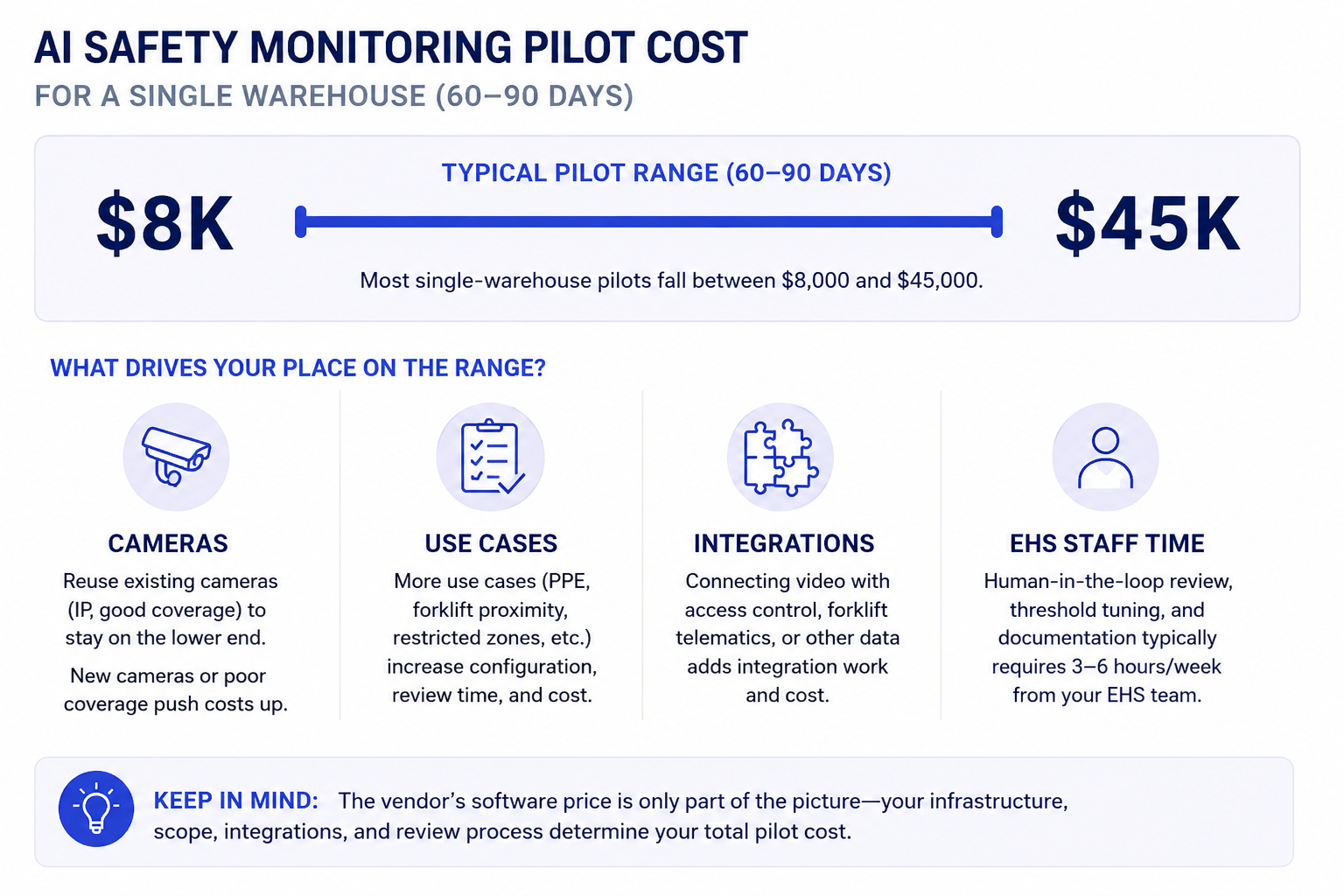
- A single-warehouse AI safety monitoring pilot typically runs $8,000–$45,000 for 60–90 days, depending on whether you reuse existing cameras or need new ones, how many use cases you test, and whether the vendor charges platform fees during the pilot.
- The biggest hidden cost isn't software — it's EHS staff time for reviewing alerts, calibrating thresholds, and running the human-in-the-loop confirmation workflow. Budget 3–6 hours/week from a safety coordinator for the pilot's duration.
- Camera reuse (vs. new hardware) is the single largest lever on pilot cost — expect a 2–4x cost difference between "use what's on the ceiling" and "install a new camera network."
- Ask every vendor for a fixed-fee, defined-scope pilot quote in writing before any conversation about annual contracts — open-ended "let's start small and see" pricing is a red flag.
- Multi-modal pilots (video + access control or forklift telematics) cost more upfront than single-camera object detection, but they cut false positives enough to be worth it if your site already has that data flowing somewhere.
Direct Answer
A single-site AI safety monitoring pilot for 60–90 days typically costs $8,000 to $45,000 all-in, driven mainly by camera count, number of use cases (PPE, forklift proximity, restricted zones, etc.), and whether existing cameras can be reused. The largest non-cash cost is EHS staff time spent reviewing and confirming AI-flagged incidents — plan for that explicitly, not as an afterthought.
What's Actually in a Pilot Budget Line Item
Most EHS directors get a single number from a vendor ("$15K for the pilot") without seeing what's inside it. Break it into five buckets so you can compare vendors apples-to-apples and catch what's missing.
1. Camera/sensor infrastructure If you're reusing existing IP cameras (the approach covered in our guide, Multi-Site Warehouse Safety: Deploying AI Detection Without New Cameras or Sensors), this line item can be near zero. If your site needs new cameras — common in older facilities with analog systems or blind spots around dock doors — budget $300–$800 per camera installed, including labor and cabling.
2. Software/platform licensing for the pilot window Vendors price this differently: per-camera/month, per-use-case flat fee, or a single pilot package price. Expect $1,500–$6,000/month for a pilot-scope deployment (typically 10–30 cameras, 2–4 use cases). Watch for vendors who quote a low monthly number but require a 12-month minimum commitment disguised as "pilot pricing."
3. Integration work If you want the system to fuse video with access control logs, forklift telematics, or machine state data (rather than video alone), integration work adds cost — usually $2,000–$10,000 one-time, depending on how open your existing systems' APIs are. Facilities running older access control systems (mag-stripe, proprietary badge systems with no API) will pay more here or may need to defer multi-modal fusion to a phase 2.
4. EHS staff time (the line item everyone forgets) Every credible AI safety platform with a human-in-the-loop model requires someone to review flagged events before any action — a coaching conversation, an incident log entry, a maintenance ticket — gets triggered. During a pilot, plan for a safety coordinator or EHS manager spending 3–6 hours per week reviewing alerts, tuning sensitivity (too many false positives = alert fatigue; too few = missed events), and documenting outcomes. At a loaded cost of $40–$60/hour, that's $500–$1,500/month in labor you should count as a real pilot cost, even though it won't appear on a vendor invoice.
5. Change management / floor communication Often skipped, always noticeable in outcomes. Budget time (not necessarily cash) for toolbox talks explaining what the cameras do and don't do — especially addressing worker concerns about surveillance. A pilot that generates floor pushback because nobody explained the human-in-the-loop review process will produce noisier data and slower buy-in.
Read more: AI Safety Monitoring Vendor Selection Scorecard for Multi-Site Warehouse Operators
The Real Cost Driver: Camera Reuse vs. New Hardware
This deserves its own section because it swings your budget more than any other variable.
If your existing cameras are IP-based, have reasonable resolution (1080p or better), and cover the zones you care about — dock doors, forklift aisles, high-traffic intersections — a vendor with genuine camera-agnostic architecture should be able to pull video feeds without new hardware. This is the cheapest and fastest pilot path: software-only onboarding can often go live in 2–3 weeks.
If your cameras are analog, low-resolution, poorly positioned, or your DVR/NVR system is old enough that pulling a live feed isn't straightforward, you're looking at new camera installation for at least the pilot zone. This adds hardware cost, installation labor, and time (often 4–8 weeks before the AI system even starts collecting data), because electricians and IT need to run the new infrastructure first.
Before soliciting quotes, do a 30-minute walkthrough of your pilot zone and answer: How old is the camera system? Is it IP or analog? Who manages the NVR — internal IT or a third-party integrator? This single walkthrough will tell you which cost bracket you're in before a vendor ever sets foot on site.
Decision Framework: Sizing Your Pilot Budget
If your site already has modern IP cameras covering your target zones → prioritize a software-only pilot vendor and expect to land in the $8,000–$18,000 range for 60–90 days. Don't let a vendor upsell new hardware "for better accuracy" until you've tested with what you have.
If your cameras are outdated or don't cover critical zones (blind spots at dock doors, forklift intersections) → budget for hardware and expect $20,000–$45,000. Consider narrowing the pilot to 1–2 use cases in the zones that most need new cameras, rather than trying to cover the whole facility on day one.
If you want to test multi-modal fusion (video + access control or machine telematics) in the pilot → add $2,000–$10,000 for integration and confirm your existing systems have an accessible API before committing. If they don't, run the pilot on video-only detection first and treat multi-modal fusion as a phase 2 expansion decision.
If your EHS team is already stretched thin → treat the staff-time line item as non-negotiable. A pilot that nobody has bandwidth to review generates data nobody acts on, which is functionally a wasted pilot regardless of price.
If leadership wants proof before a multi-site commitment → structure the pilot as single-site, fixed-scope, fixed-fee, with a written exit clause if it doesn't hit agreed success criteria. This is the model worth insisting on regardless of vendor — it's the only way to de-risk a decision that could otherwise become a multi-year, multi-site contract based on a demo.
Worked Example: A 3-Use-Case Pilot at a Mid-Size DC
Facility profile: 180,000 sq ft distribution center, 22 existing IP cameras covering dock doors and main aisles, badge-based access control system with an open API, one safety coordinator (0.5 FTE available for the pilot).
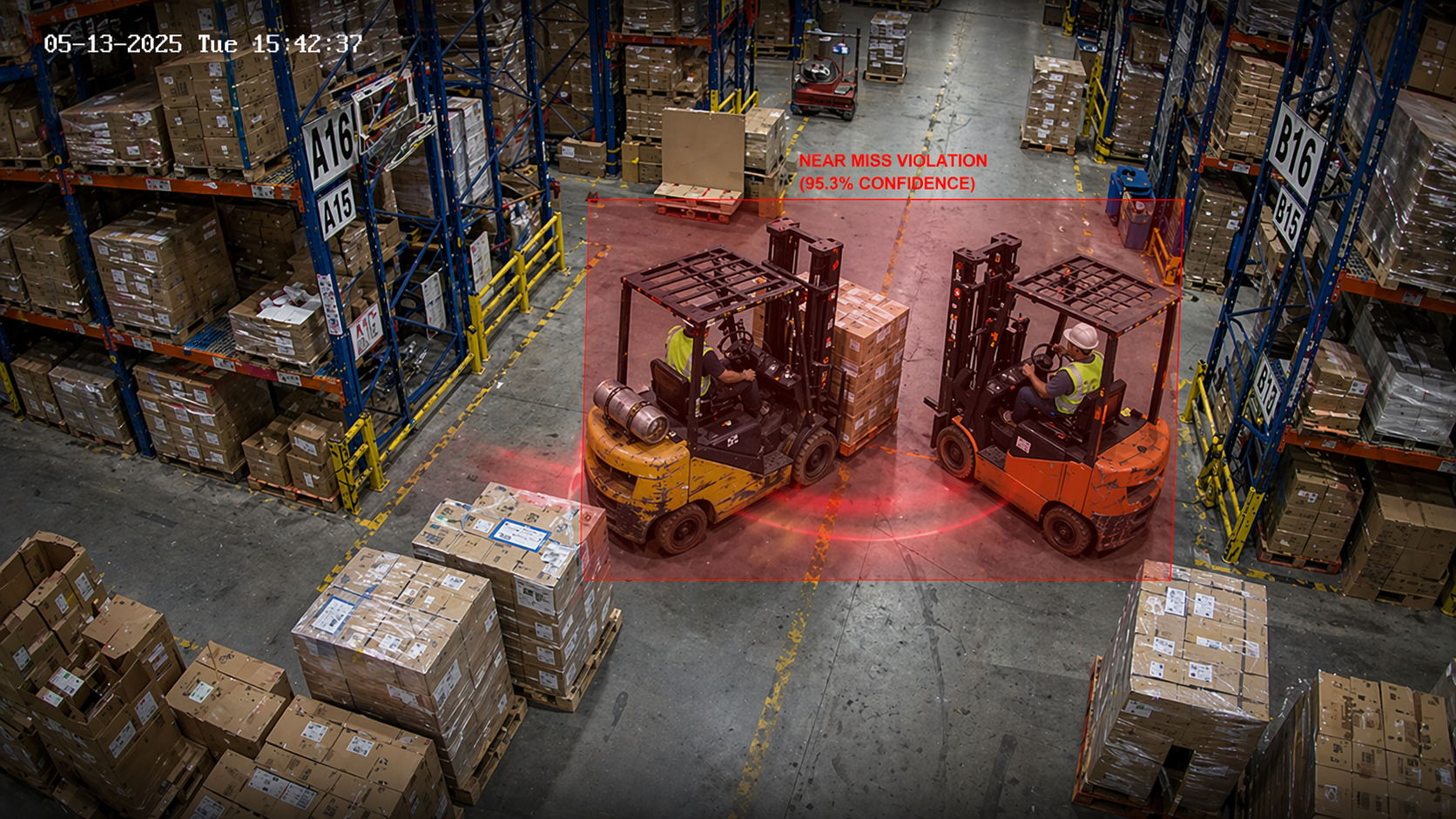
Scope: 90-day pilot covering PPE compliance at two dock doors, forklift-pedestrian proximity in the main aisle, and unauthorized zone entry near a chemical storage area — using existing cameras plus a fusion feed from access control logs at the chemical storage door.
Estimated pilot cost:
- Software/platform (18 cameras in scope, 3 use cases, 90 days): $9,000
- Access control integration (one-time): $3,000
- New cameras (2 needed to cover a blind spot near chemical storage): $1,200
- EHS staff time (4 hrs/week × 13 weeks × $50/hr): $2,600
- Total pilot cost: ~$15,800
Compare that to a full-site deployment across 22 cameras and 5 use cases with no reuse discount, which could run $35,000–$50,000 for the same window — illustrating why scoping the pilot tightly to 2–3 use cases in a defined zone, rather than "everything, everywhere," keeps both cost and review workload manageable.
Where This Budgeting Approach Breaks Down
Being upfront about limitations:
- Facilities with no camera coverage in the zones that matter most (common in older buildings or outdoor yard areas) will always cost more than these ranges suggest — new camera runs, trenching for cabling, or wireless camera solutions can add thousands beyond the estimates here.
- Multi-modal fusion is only as cheap as your existing systems' openness. If your access control or machine telematics vendor charges heavily for API access or doesn't support real-time data export, integration costs can balloon past the $2,000–$10,000 range cited above — get a quote from your existing systems vendor before assuming this cost.
- Staff time estimates assume a functioning review workflow already exists. If your EHS team has no established process for triaging alerts (safety software or otherwise), the real time cost during a pilot will run higher than 3–6 hours/week as the team builds that muscle.
- These figures are pilot-scope, not production-scope. A successful pilot will almost always lead to a larger, different pricing conversation for site-wide or multi-site rollout — don't assume pilot pricing is a preview of long-term contract pricing.
[PLACEHOLDER: cite relevant OSHA or industry stat on warehouse incident rates/costs from your data, if available, to strengthen the case for pilot ROI]
FAQ
How much does an AI safety monitoring pilot cost for one warehouse
Most single-site pilots run $8,000–$45,000 for a 60–90 day window, depending on whether existing cameras can be reused, how many safety use cases are tested, and whether the vendor requires new hardware or integration work. The single biggest cost swing is camera reuse versus new camera installation.
Do I need new cameras to run an AI safety pilot?
Not necessarily — if your existing cameras are IP-based, reasonably high resolution, and positioned to cover the zones you want to monitor, most modern AI safety platforms can pull those feeds without new hardware. Analog or outdated camera systems typically require new installation, which adds both cost and 4–8 weeks of lead time.
What hidden costs should I budget for beyond the vendor's quote?
The most commonly missed cost is EHS staff time for reviewing AI-flagged events under a human-in-the-loop model — typically 3–6 hours per week during a pilot. Integration costs for connecting video to access control or machine data systems, and change management time to brief the floor, are also frequently left out of vendor-provided quotes.
Should I negotiate a fixed-fee pilot instead of a monthly subscription?
Yes — insist on a fixed-fee, fixed-scope pilot quote with a defined start and end date, rather than open-ended monthly pricing that could imply a longer commitment. This protects you if the pilot doesn't meet your success criteria and keeps the decision to scale (or not) entirely in your hands.
Is a multi-modal pilot (video plus other data) more expensive than video-only?
Generally yes, by roughly $2,000–$10,000 for integration work, but only if your existing systems (access control, machine telematics) have accessible APIs. If they don't, it's often more cost-effective to pilot video-only detection first and evaluate multi-modal fusion as a follow-on phase.
Ready to scope your own pilot budget with real numbers instead of vendor estimates? Use the Proof of Concept Worksheet to define success criteria, cost boundaries, and exit conditions before you talk to a single vendor.